Parallel Exhibition: An ACP-Based Framework for Organization and Management of MICE Systems
DOI:
https://doi.org/10.61702/nkbcm104Keywords:
Parallel Exhibition, ACP, Parallel Intelligence, MICE Management, Complex Systems, Digital HumanAbstract
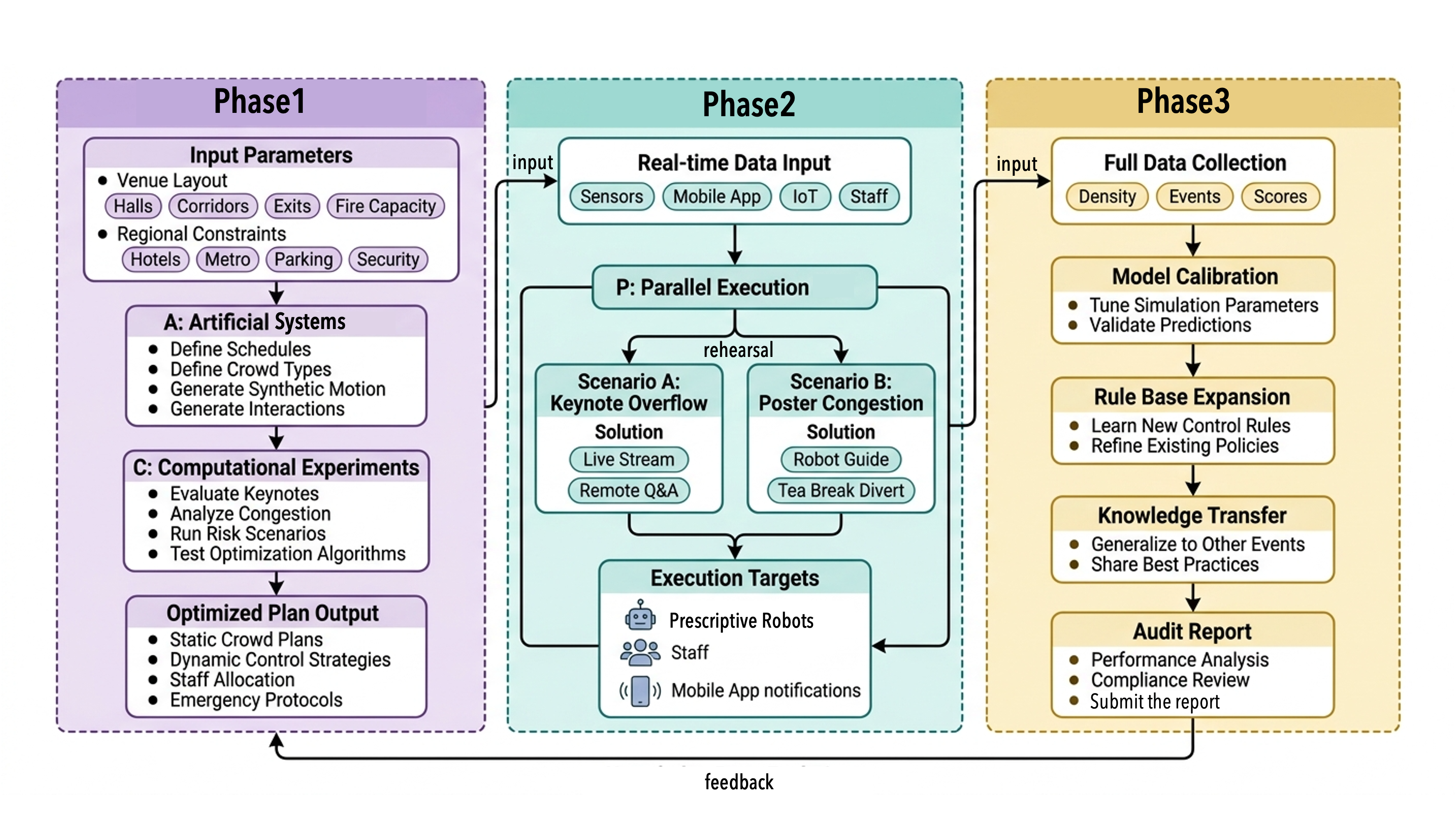
The MICE (Meetings, Incentives, Conferences, and Exhibitions) industry serves as a critical infrastructure of the global service economy, combining huge economic scale with an irreplaceable knowledge spillover function. However, the essential characteristics of temporary organizations give rise to multidimensional management challenges, including multi-participant conflicts, spatiotemporal uniqueness, rigid regional constraints, and emergent crowd behavior. Existing project management tools, isolated technologies, and digital twin methods are all insufficient to address these complex challenges. In this paper, we propose a parallel exhibition intelligent management framework based on the ACP (Artificial systems, Computational experiments, Parallel execution) approach. We design a collaborative mechanism among three types of humans---biological humans, digital humans, and robotic humans---to enable virtual-real closed-loop management. The framework aims to achieve coordination among participants, transferable experience accumulation, and real-time dynamic regulation through the ACP approach, addressing systemic management challenges in the MICE industry through a system-level approach and offering a reference for the intelligent management of complex social systems.
Downloads
Downloads
Published
Issue
Section
Categories
License

This work is licensed under a Creative Commons Attribution 4.0 International License.
Authors retain copyright to their published work and retain full publishing rights without restriction. Articles are published under the Creative Commons Attribution 4.0 International License (CC BY 4.0), which permits sharing and adaptation for any lawful purpose provided that appropriate credit is given to the authors and the original publication is cited.
Authors grant JCPSI and the Association of Global Intelligent Science and Technology (AGIST) a non-exclusive right of first publication and the right to identify JCPSI as the original publisher of record.
Authors may deposit and make publicly available the submitted version, accepted manuscript, and published version of record in an institutional repository, disciplinary repository, funder repository, personal website, or other repository of their choice without embargo, provided that the published article is cited and the journal version of record is linked when available.
How to Cite