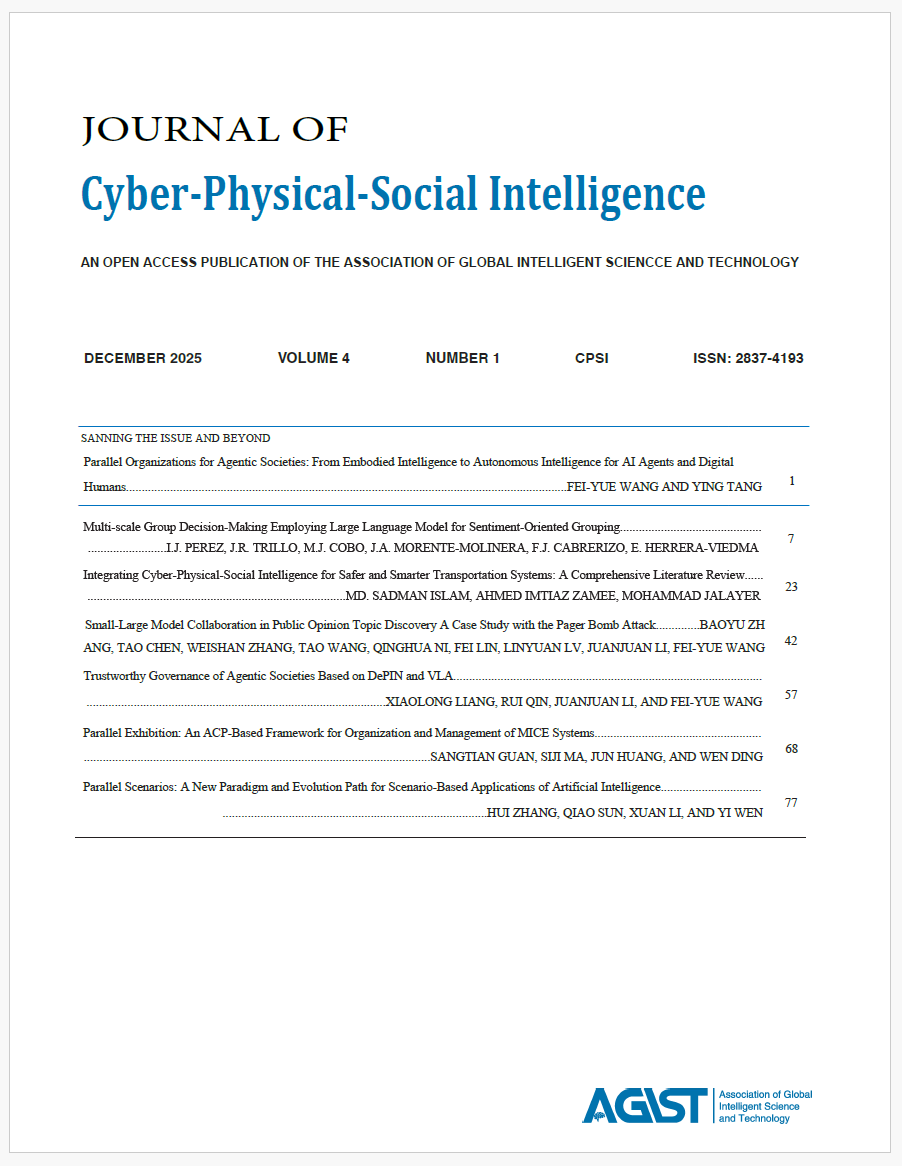
Parallel Organizations for Agentic Societies:From Embodied Intelligence to AutonomousIntelligence for AI Agents and Digital Humans
DOI:
https://doi.org/10.61702/npqyhz14Keywords:
Agentic Societies, Parallel Organizations, Autonomous Intelligence, AI Agents, Digital Humans, Parallel Intelligence, ACP Approach, Organizational GovernanceAbstract
We are living through an epochal shift in the nature of work, collaboration, and collective action. AI agents, digital humans, and physical robots are no longer auxiliary tools but autonomous, goal-directed participants in organizational life---capable of long-task execution, cross-agent communication, workflow orchestration, and adaptive decision-making at scale. AI systems can now reliably complete tasks of roughly two hours in length, doubling in capability every four months since 2024; up to 57\% of current work hours in the United States are technically automatable, with virtual agents covering 44\% and physical robots 13\%~\cite{ed1}. By 2030, this transformation could unlock approximately \$2.9 trillion in annual economic value~\cite{ed2}. Yet despite this explosive technological progress, organizational theory has failed to keep pace. We continue to rely on frameworks designed for human-only hierarchies~\cite{ed3}, markets~\cite{ed4}, and networks~\cite{ed5}---structures ill-suited to govern hybrid collectives of humans, digital agents, and robotic actors. To situate this challenge, the 2025 issue of the Journal of Cyber-Physical-Social Intelligence (CPSI) brings together a set of articles that collectively reflect several key dimensions of intelligence, coordination, and governance in the emerging agentic society.
Building on these contributions, this editorial introduces the conception of \textbf{Parallel Organizations for Agentic Societies (POAS)}: a unified, theoretically grounded, and operationally actionable framework for designing, governing, and evolving organizations in the age of autonomous AI agents and digital humans. POAS is a paradigm built for agentic societies from first principles. It integrates advances in parallel intelligence with the ACP approach~\cite{ed6}: Artificial societies, Computational experiments, Parallel execution, continuous organizational forms, distributed governance, cyber movement mobilization, and embodied-to-autonomous intelligence evolution. In doing so, it resolves four interconnected gaps that have fragmented research and practice: ontology, coordination, governance, and mobilization. Against this backdrop, the core thesis is straightforward: \textit{the future of intelligence is not individual but organizational}. The transition from embodied, task-specific intelligence to generalized, autonomous intelligence in AI agents and digital humans will not be achieved in isolated systems, but through parallel organizations that enable virtual--real coevolution, continuous experimentation, and emergent collective wisdom.
Downloads
Downloads
Published
Issue
Section
Categories
License

This work is licensed under a Creative Commons Attribution 4.0 International License.
Authors retain copyright to their published work and retain full publishing rights without restriction. Articles are published under the Creative Commons Attribution 4.0 International License (CC BY 4.0), which permits sharing and adaptation for any lawful purpose provided that appropriate credit is given to the authors and the original publication is cited.
Authors grant JCPSI and the Association of Global Intelligent Science and Technology (AGIST) a non-exclusive right of first publication and the right to identify JCPSI as the original publisher of record.
Authors may deposit and make publicly available the submitted version, accepted manuscript, and published version of record in an institutional repository, disciplinary repository, funder repository, personal website, or other repository of their choice without embargo, provided that the published article is cited and the journal version of record is linked when available.
How to Cite